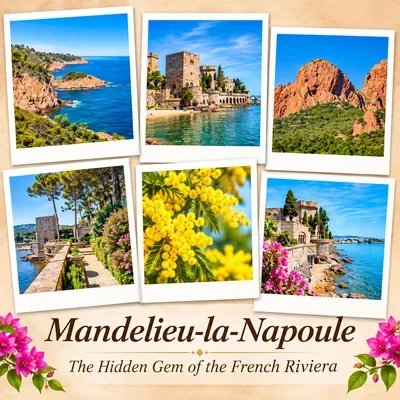
When we think of the French Riviera, the same images often come to mind: the elegance of Cannes’ Croisette, the luxury yachts of Saint-Tropez, the bustling markets of Nice, or the vibrant harbor of Marseille. Golden beaches, sunsets over the Mediterranean, fresh seafood, and glasses filled with chilled Provençal rosé.
But the Côte d’Azur has much more to offer.
Beyond the famous resorts lies a destination where life moves at a gentler pace, where the beaches are less crowded, the sunsets just as spectacular, and where visitors can still discover the Riviera’s authentic charm. That place is Mandelieu-la-Napoule.
Where the Riviera Slows Down
Located just a few kilometers west of Cannes, Mandelieu-la-Napoule is a unique blend of seaside resort, historic town, and natural retreat.

While many travelers come to the Riviera seeking film festivals, luxury boutiques, and glamorous beach clubs, Mandelieu offers something different: peaceful beaches, secluded coves framed by red cliffs, blooming mimosa forests, and breathtaking mountain views.
Here, there is no rush. Mornings begin with coffee by the marina, afternoons are spent exploring the coastline or hiking in the hills, and evenings stretch into long dinners accompanied by a glass of rosé or a traditional pastis.
The Fairytale Château de la Napoule
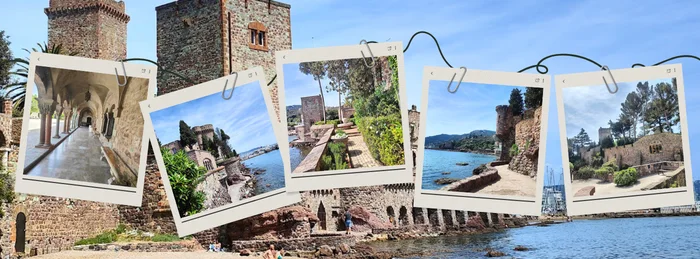
The town’s most iconic landmark is the stunning Château de la Napoule, a castle whose history dates back to the Middle Ages.
Originally built as a fortress, it was largely destroyed during the French Revolution. The romantic castle visitors see today was lovingly restored in the 1920s by American artist Henry Clews Jr. and his wife, Marie.
Part residence, part artistic masterpiece, the château features Gothic-inspired dining rooms, elegant salons, panoramic Mediterranean terraces, and enchanting gardens. Throughout the property, visitors can admire Henry Clews’ sculptures and artwork, while winding pathways lead through beautifully landscaped grounds filled with ponds, carved greenery, and hidden corners.
Today, the château serves as both a museum and an arts foundation, making it one of the most distinctive cultural sites on the French Riviera.
The Capital of Mimosa
Mention Mandelieu-la-Napoule to locals, and one word immediately comes to mind: mimosa.
The town is considered Europe’s mimosa capital. During the winter months, its surrounding hills are transformed into a sea of golden blossoms. Originally introduced from Australia in the 19th century, the mimosa has become an essential part of the region’s identity.
Every February, the town celebrates the famous Mimosa Festival, a vibrant event featuring flower-covered floats, marching bands, and festive parades. The entire town comes alive as the scent of mimosa fills the air and announces the arrival of spring.
San Peyre: The Most Beautiful Viewpoint
Rising above the town, San Peyre Hill offers one of the most spectacular viewpoints on the Riviera.
An easy walking trail winds through pine and mimosa trees before reaching the summit, where the ruins of an ancient fortress overlook the landscape. From here, visitors can admire panoramic views of the Bay of Cannes, the Esterel Mountains, and the Lérins Islands.
At sunset, the scenery becomes truly unforgettable.
The Red Mountains of the Esterel
One of Mandelieu’s greatest natural treasures is its proximity to the Esterel Massif.
Formed from volcanic rock, the mountains are famous for their striking red cliffs, which create a dramatic contrast against the deep blue waters of the Mediterranean. Hundreds of kilometers of hiking and cycling trails cross the massif, revealing constantly changing landscapes of forests, rugged peaks, and coastal vistas.
The highest point, Mont Vinaigre, rises more than 600 meters above sea level and rewards visitors with extraordinary views across the Riviera.

For those who prefer exploring by car, the Corniche d’Or is one of the most scenic coastal drives in southern France.
Quiet Beaches on the Riviera
Mandelieu-la-Napoule is home to nine public beaches, many of them tucked between the red rocks of the Esterel coastline.
The long sandy stretch of Plage de Robinson is popular with families, while the smaller coves of La Rague and La Raguette offer a more intimate atmosphere.
With crystal-clear waters, fewer crowds, and stunning Mediterranean scenery, these beaches provide a welcome escape from the busier stretches of the Côte d’Azur. Here, it is still easy to find a peaceful spot where the only sounds are the waves and the cries of seabirds overhead.
Pointe de l’Aiguille: Where Red Cliffs Meet the Sea
Just beyond nearby Théoule-sur-Mer lies Pointe de l’Aiguille, one of the Riviera’s most spectacular protected coastal landscapes.
Here, the red cliffs of the Esterel plunge dramatically into the sea, creating hidden coves, unusual rock formations, and some of the clearest waters along the coast. Because motorized boats are restricted in the area, the site is particularly popular for snorkeling and diving.
Walking along the coastal trails reveals one breathtaking panorama after another, showcasing why this corner of the French Riviera is considered one of its most beautiful natural treasures.
The Riviera’s Other Side
Mandelieu-la-Napoule is not about red carpets, luxury yachts, or the spotlight.
It is about slow mornings, seaside walks, mimosa-scented hills, red cliffs glowing in the sunlight, and those quiet moments when the French Riviera reveals its softer, more authentic side.
This is a place where visitors can still experience the true spirit of the Côte d’Azur—away from the crowds, yet close to everything that has made this coastline legendary.
And perhaps that is exactly why it is so easy to fall in love with it.